



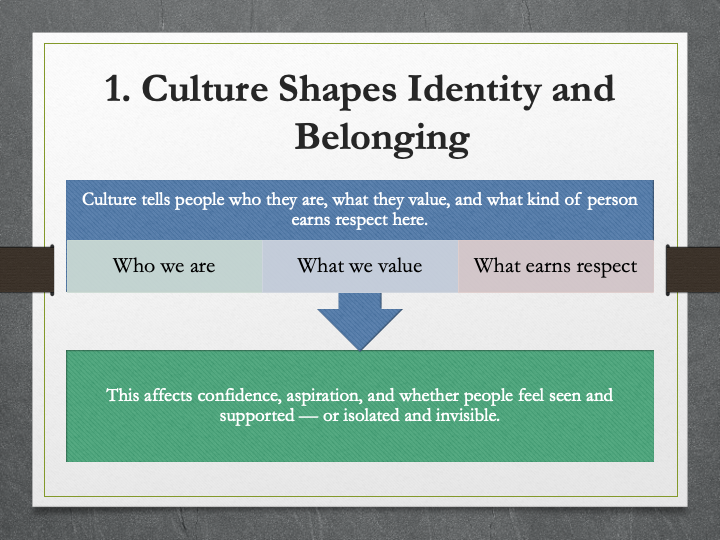
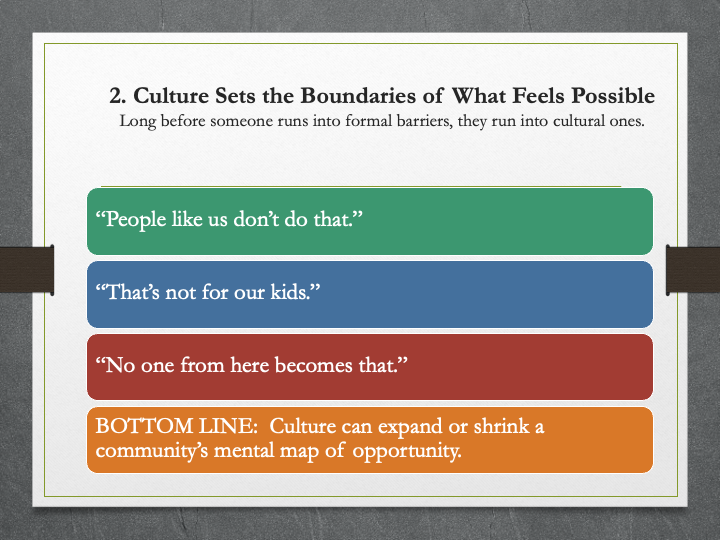
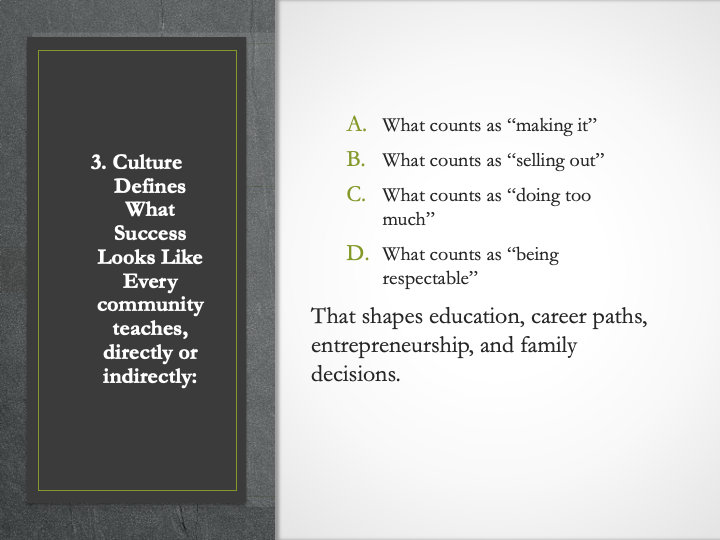
So Culture Is Important. Did African-American Culture Flow From Our Genes?
Our Culture is not genetically based. From W.E.B DuBois (The Souls of Black Folk), to Carter G. Woodson (The Mis-Education of the Negro), to Paul Gilroy (The Black Atlantic), to Elijah Anderson (Code of the Street) to Ta-Nehisi Coates (Between the World and Me), this issue has been examined and discussed and this genetic theory utterly rejected.
Are there some African-Americans who seem to believe that their culture flows from their genes just as their skin color does? Undoubtedly. But this view of a gene based culture is not limited to African-Americans. Some within other groups believe their culture is gene based.
The reality is quite simple: history, social environment, law, institutions, and experience combine to determine culture.

Since Humans Can Greatly Shape What Their Culture Will Be (Although Change Will Take Time), What Culture Should African-Americans Aim For?
-
The Ever Changing But Persistent Need For A Great Family Culture
We Take As a Basic Assumption That Our Children, The Father and Mother Are Well Served By The Traditional Two-Parent Household.
We Also Take As a Basic Assumption That Humans Are Not Born With the Maturity and Wisdom and Demeanor Needed to Make the Husband and Wife Relationship Flourish.
So What Can the Fayette County Do to Help In this Area?
-
Cultural Traits To Emphasize: Adaptability and Resilience
🔄 Adaptability
Adaptability is the ability to adjust your thinking, behavior, and expectations in response to new conditions or challenges.
It means:
a. Letting go of rigid routines or beliefs when they no longer serve you
b. Learning new skills or ways of thinking quickly
c. Navigating change—whether it's sudden (like a job loss) or slow (like aging or societal shifts)
d. Remaining open-minded and solution-focused even when outcomes are unclear
Example: Switching careers midlife, adjusting to a new culture, or learning how to communicate in new relationships.
🛠️ Resilience
Resilience is the capacity to recover from adversity, trauma, or stress—and often come back stronger or wiser.
It means:
a. Bouncing back after failure, grief, or hardship
b. Maintaining hope and purpose during hard times
c. Regulating emotions under pressure
d. Learning from setbacks instead of being defeated by them
Example: Coping after the loss of a loved one, recovering from financial hardship, or healing from discrimination or injury.
Together: Adaptability + Resilience
These two qualities complement each other. Adaptability helps you respond during change, while resilience helps you recover after hardship.
A truly adaptable and resilient person doesn’t just endure change—they engage with it, using it as a catalyst for growth.
Why It Matters Now
In today’s rapidly shifting world—climate crises, political instability, tech disruption—being adaptable and resilient isn’t just a personal strength. It’s a survival skill, a leadership trait, and a path to long-term well-being.
So What Can the Fayette County Branch Do To Help In This Area?
-
We Don't Need to Work Twice As Hard: But You Must Work Hard and Work Smart
Do You Remember When These Businesses Were Spread All Over the US?
1. Blockbuster (video rental)
2. Blackberry (smartphones)
3. Tower Records (music retail)
4. Kodak (photography)
5. Zenith Electronics (tv and radio)
6. Olivetti (typewriters)
If they survive today, they are a shadow of their former selves. Did they fail because their managers and employees did not work hard enough? Or did they fail because leadership failed to recognize the dangers to their business that a changing technological environment posed?
We live in a country that is at the center of many of the technological changes that are being developed today. Will our community adapt to those changes so that the community can continue to advance? When these changes cause financial or other hardships to some, will they have the resilience and support needed to overcome these adversities?
In the Economic Empowerment section of this website, we discuss the goal of Economic Empowerment and ways to get there.
There are some cultural dogmas that have helped our community to survive bad things that happened to them. In addition, some of these dogmas are useful to advance within a particular role (of Passenger, Operator, Owner or Platform Owner as discussed in the Economic Empowerment discussion).
While these dogmas often start as survival mechanisms, they can become detrimental when they prevent an individual from moving up the Train → Operator → Owner ladder.
To move up this model, an individual must often "betray" a lower-level dogma to embrace a higher-level logic.
1. Dogmas that Trap You on "The Train" (Utility)
These mindsets are often rooted in a scarcity environment where the goal is immediate survival, making long-term planning feel like a luxury.
"The Bird in the Hand" Dogma: The belief that a guaranteed low-wage job today is always better than training for a high-wage career tomorrow.
The Detriment: It prevents the leap to "Operator" status because the individual refuses to "lose" a day’s wages to attend a certification class or workshop.
"The Hustle Fallacy": The idea that working harder (more hours on the train) is the only way to get ahead, rather than working differently (learning to drive the train).
The Detriment: It leads to burnout and prevents the "Agency" required to seek out "Operator" skills.
2. Dogmas that Block the "Operator" (Systems)
These mindsets often stem from a lack of "Knowledge Continuity" or a distrust of formal systems.
"The Specialist's Secret": The belief that you should hide your knowledge so others can't replace you.
The Detriment: In the "Operator" phase, your value grows when you can manage others. If you refuse to share knowledge, you can never lead a team, keeping you stuck as a "solo operator" rather than a manager or owner.
"Anti-Intellectualism" (Crabs in a Bucket): When someone pursues higher education or a "white-collar" skill, they are accused of "acting better than" the community or "forgetting where they came from."
The Detriment: This creates a massive psychological barrier to Economic Empowerment. It forces people to choose between their community identity and their professional growth.
3. Dogmas that Prevent "Ownership" (Equity)
Ownership requires a shift from "consumption" to "capital," which can clash with social norms regarding wealth and generosity.
"The Family Tax" (Hyper-Sharing): The dogma that if you have any "extra" money, it must immediately be distributed to struggling family or friends.
The Detriment: While this is a beautiful expression of the Golden Rule, it prevents the "Owner" phase. To become an owner, you must have retained earnings to invest. If every surplus is drained, you can never buy the "tracks."
"The Zero-Sum Myth": The belief that for someone to be an "Owner," they must have stolen from or exploited someone else.
The Detriment: This leads to a moral guilt about wealth. If a community believes all "Owners" are "Amys" (fraudsters), then "good people" will subconsciously sabotage their own path to ownership to remain "virtuous."
-
My Word Is My Bond
For the Golden Rule to function as a protection against crime and fraud, the community must move from "external policing" to "internal accountability."
The Trait: A culture where "keeping one’s word" is the highest form of social currency.
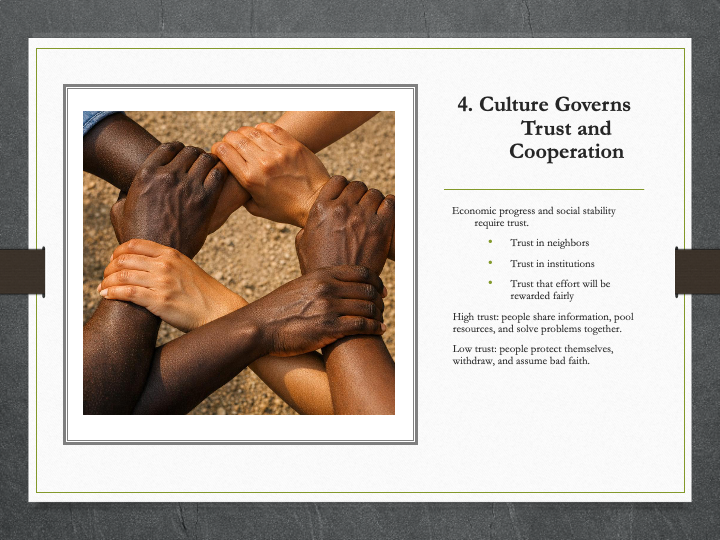
Economic Impact: High trust lowers "transaction costs." When neighbors trust each other, they can form investment clubs, co-ops, and partnerships without the fear of being "defrauded by an Amy."
Crime Impact: Communities with high internal trust have lower crime rates because they practice Collective Efficacy—the ability of a group to regulate the behavior of its members through social norms rather than just the police.
-
The Ownership Culture
To move from the Train to the Owner, a community must foster a culture that prioritizes delayed gratification and equity over immediate consumption.
The Trait: Viewing oneself as an "Ancestral Architect." This means making decisions based on how they will affect the community three generations from now.
Empowerment Impact: This shifts the cultural dogma from "spending to look wealthy" to "investing to be powerful." It normalizes saving and capital accumulation as a communal virtue.
Learning Impact: A future-oriented culture views education as a long-term asset, making children more resilient when learning becomes difficult.
-
Civic Assertiveness & Legal Literacy
To secure protection against discrimination, a community cannot be passive; it must be strategically vocal.
The Trait: A culture that prizes "Knowing the Rules to Play the Game." This involves a community-wide obsession with understanding the law, civil rights, and local government.
Anti-Discrimination Impact: When a community is legally literate, "vices" like discrimination are met with immediate, organized, and sophisticated legal or economic responses rather than just frustration.
Justice System Impact: Knowledge of rights reduces "induction into the criminal justice machinery" by ensuring individuals know how to navigate encounters with authority and have the community support to demand due process.
-
Intellectual Curiosity & "Psychological Safety"
To create an ideal environment for learning and discovery, the community must celebrate the "Search for Truth" above "Correctness."
The Trait: Celebrating the "Growth Mindset." In this culture, failure is viewed as "data," and asking questions is viewed as a sign of strength, not ignorance.
Learning Impact: This eliminates the "Anti-Intellectualism" dogma. It creates a "Psychological Safety" zone where students feel safe to explore "maps" that their parents never walked.
Innovation Impact: Discovery happens when people feel safe to experiment. A community that fosters curiosity will naturally produce more "Map-Makers" (Entrepreneurs and Innovators).
-
Black People Don't; Whites Don't
While comedians love jokes based on this observation, it is another reflection of cultural traits vesus genetically inbred thoughts and feelings. Often there is nothing wrong with laughing about the cultural traits of one community versus another so long as we don’t get twisted into thinking these are genetically based. That is sometimes a dangerous assumption that others make about you. It can also be a dangerous assumption that you make about yourself or your community.