

Big ideas, real impact. Economic Empowerment: A Definition.
Economic empowerment is the capacity of individuals and communities to move from riding within other people’s systems to owning and governing the systems that shape their lives.
THE ANALOGY: USING THE IDEA OF A RAILROAD TO EXPLAIN WHAT ECONOMIC EMPOWERMENT IS.
An enterprise (e.g. the company you work for or the company you own) is the train.
You as an individual have a role that you perform with respect to the train. You may be:
A Passenger (meaning you work on the train to perform certain services in exchange for a wage); or
An Operator (meaning you manage the people, processes or equipment used by the train system, but you are not an owner of the train system who has control over the trains and the rest of the system);
Owner (meaning whether you work for the train or not, you own the underlying assets of the train and its system and have the power to choose operators and passengers for the train).
A platform is the rail system that determines who can run trains, where they can go, and what they must pay to operate.
Economic empowerment depends on whether individuals and communities merely ride trains (acting as a Passenger), run trains (acting as an Operator), own trains (acting as an Owner), or design the rail system itself (acting as a Platform Architect).
We will discuss this analogy in more detail later but want to stop here to make a basic point.
Do not assign any moral virtues or failures based on your relationship with the train.
Being a passenger is not a failure
Being an operator is not liberation
Being an owner is not virtue
They are positions, not identities.
Why Seek Economic Empowerment?
-
Why Economic Empowerment?
From the Caribbean island nations led by the descendants of African slaves, to the countries of Africa, most of which were created by Western colonial powers, to the African-American community in the Untied States of America, people all over the world seek to obtain for themselves and their community the unalienable Right to:
a. Life;
b. Liberty; and
c. The Pursuit of Happiness.
To that end, they have formed their own governments or participate in the government in the country in which they live to:
d. establish Justice;
e. promote the general Welfare;
f. provide for the common defence; and
f. secure the Blessings of Liberty to themselves and to their Posterity.
For each of the elements described below, there is an economic component. Paying for your justice system (including law enforcement) and your common defense to help protect both your life and your liberty. Structuring your economy to improve the general Welfare and enhance the ability of your community to pursue happiness, and justice and liberty.
Putting yourself and your community in a position to experience these “Rights” is the “why” of Economic Empowerment.

Managing Your Money: A Challenge Every Human Faces (Rich or Poor)
Economic Empowerment comes from handling personal finances so that they move in the right direction.
Every American faces the challenge of handling their personal finances. Whether you are a high school dropout or a newly minted surgical doctor or a software developer or a project manger for artificial intelligence initiatives in you company or a clerk at your local bank, you will face challenges in handling your personal finances. Consider the following three examples.
1️⃣ The High-Earning College Grad
Scenario: Jamal recently graduated and landed a high-paying job earning him over $100,00 a year (when potential bonuses are included);
His Challenge: The lure of an exciting lifestyle fancy apartment in a very upscale part of town, new car (he did need a car to get to work), frequently dines out at trendy restaurants, travel to Europe and Japan or similar places each year-can eat up his income fast.
Financial Risk: While Jamal makes $75,000 as his base salary, after his expenses, he only has $600 a month left. Jamal loves his lifestyle and currently is fine with paying rent and does not prioritize buying a home. Currently Jamal's liquid assets and net worth are the same: $7,500. His Debt-to-Income Ratio is 48% if one ignores his planned travel for the year.
2️⃣ The Burdened Grad
Scenario: Velzon also graduated from college at the same time as Jamal but his degree in political science did not open the door to a lot of good job opportunities from a salary standpoint. Currently he is a customer service rep at the local branch of a national bank making about $45,000 a year. Velson's student loan payments of $450 a month will start in 3 weeks. Velson also had to purchase a car to get to his job and to get around town. Velzon found a roommate to share the rent payments, but he still has to pay $1,000 a month for rent including utilities.
Challenge: Velzon wants to do many of the same things Jamal is doing although his priorities differ: Velzon likes dancing, so he spends more money on clubs than restaurants; Velzon is also a huge sports fan and wants to buy season tickets to both the town's football and basketball teams.
Financial Risk: After all of his expenses (he has not purchased any season tickets yet), Velzon has $500 a month leftover. When his student loans start, he will have $50 a month leftover. Velzon's parents gave him $7,500 for furniture and furnishings. He spent $1500 of that for a bed and mattress and still has $6,000 left over. Velzon's liquid assets net worth is -$35,000. His Debt-to-Income Ratio will be 27% and his Financial Asset Ratio is 17%.
3️⃣ The High School Drop
Scenario: Peggy decided to drop out of high school at age 17. She did not like school, did not do well in classes and saw some of her older siblings and friends making $20.00 an hour in a local warehouse. However, Peggy soon found out that the actual starting salary at most warehouses was $16.00 an hour, not $20. That was still better than working at Burger King so Peggy started work at the warehouse. Her annual salary was $33,300 a year. In addition, Peggy worked about 20 hours of overtime a week for two months during the holiday season at a rate of $24.00 an hour. This earned Peggy an additional $1,280 a year.
Her Challenge: Peggy looked at getting an apartment but soon realized that with the cost of the car she needed plus other expenses, she was better off staying at home with her parents for a couple of years. Without any debt other than her car note, Peggy was able to save $10,000 at the end of her first year of work. In the short term, things were looking up for Peggy. But she soon realized that her dream of buying a $300,000 home would be very difficult. She could only count of $2,775 a month in gross income. Even if she saved up enough to put down 10% on her house, the monthly house note would be $1619 plus an extra $200 a month for Private Mortgage Insurance required by her mortgage company. Then add in her car note of $350 a month and the $300 a month she paid for medical insurance through her employer. That would leave her with $300 a month for all of her other expenses including home insurance, car insurance, electricity, gas and water and sewer collection, food, church donations, going out for movies everyonce in a while and gasoline plus car repairs.
Financial Risk: Currently Peggy’s net worth is $10,000 (since Peggy put $2,000 down on the car, her loan balance is roughly equal to the current value of her car). Her of $350 a month on the car note compared to an income of $2775 a month gives here a Debt-to-Income Ratio is 12.6% and her $10,000 in liquid assets when divided by her $35,000 in total assets ($10K in cash and $25K for the car) makes her Financial Asset Ratio is 28.6%.
A WORD ON RACISM IN AMERICA AND PERSONAL FINANCIAL HEALTH.
As noted above, every American faces personal finance challenges but the challenges vary from person to person as you can see in the examples of Jamal, Peggy and Velzon. None of them have enough net worth to be included in the middle class despite their income levels.
Among black households in the United States, roughly 20% of them have net worths in excess of $250,000 with 5% having net worths in excess of $1,000,000.
Roughly 24% of black households have net worths of $0 or less, compared to 8.6% for whites.
More than 58% of black households have net worths that place them below the threshold for being considered middle class. For white households, more than 26% of them fall below middle class.
These numbers illustrate the reality of sayings such as “When White America catches a cold, African Americans catch the flu.” This saying is not true for all African Americans but it reflects the reality for a very large portion of our community.
The reality of American life for African Americans over the vast majority of our history in this country is that a lot of people, particularly but not exclusively in the South, have spent a lot of time and energy since slavery formally ended to ensure that we don't get three things: money, the vote, and a good education.
Listen to James Vardaman, Governor of Mississippi (and also a former US Senator):
"As long as the Negro owns land, votes, or acquires education, he is a menace."
Or John Gordon, the Governor of Georgia (and also a former US Senator and Confederate General)
"We must maintain white supremacy... or the white man will be forced to share his wealth and civilization with an inferior race.”
One need not definitively answer the question of whether racial discrimination in America remains the primary cause for the relative lack of wealth (net worth) within the African American community.
But consider this:
• If racism does not exist as a meaningful barrier, we each would still face the challenge of increasing our household incomes while managing our finances properly.
• If racism remains a meaningful barrier, then we are required to exert even more energy to ensure that we go where the income is and that what finances we have are managed properly.
So we must continue the fight for justice in this society. And we must continue the personal fight to build good financial health in our personal finances. When we get the opportunity to have a good education, the vote or a better financial condition, WE MUST GRAB HOLD AND DON'T LET GO.
5 Critical Personal Financial Metrics For You.

How to Calculate Your Financial Vital Sign Scores
Your financial vital sign scores are a snapshot in time showing you were you stood at the time you made your calculations. As you perform these calculations, save them. This will allow you to track your progress (or lack thereof) over time.
To aid you in performing these calculations, we are developing a worksheet to walk you through the calculations. Stay tuned!
How would you describe the financial health of Peggy and Jamal and Velzon as described in the previous section? Their examples show that financial health is not about how much money you make. It is about how well you can survive shocks (whether job layoffs, medical issues or unexpected home or auto repairs), how well you manage your cash flow and how well you build towards long-term security. But can we be more precise about describing their and your financial health?
ABSOLUTELY!
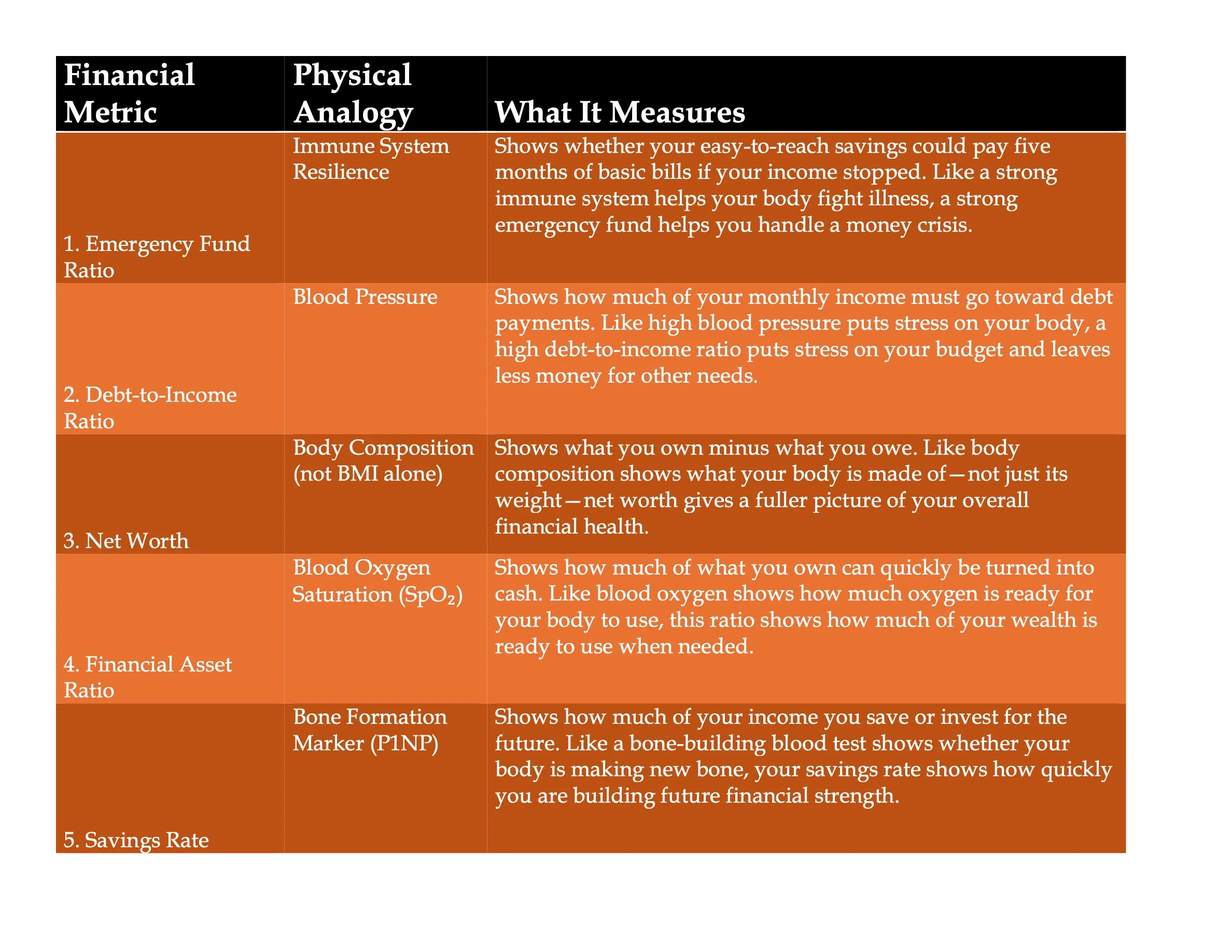
Just as a physician uses a "vital signs" panel to look past how you feel and see how your body is actually functioning, you need objective metrics to diagnose the true state of your financial life. Relying on your bank balance alone is like judging your health based on whether you have the energy to get out of bed—it doesn't tell you if there is an underlying "silent killer" like high debt or an "immune deficiency" in your savings. By tracking these five metrics, you move from guesswork to financial cartography, creating a precise map of where you stand so you can navigate toward true ownership.
The five Financial Vital Signs are shown in the table to the right.
Why These Metrics Matter for "Map-Making"
In your framework of moving from The Train to The Owner, these metrics serve as the sensors on your dashboard:
The Emergency Fund Ratio ensures that if the "train" breaks down, you aren't stranded.
Net Worth tracks your progress toward becoming an Owner—it is the ultimate scoreboard of equity.
Debt-to-Income tells you if you have the Agency to make a move, or if you are "tethered" to the tracks by your creditors.
Financial Asset Ratio ensures you have the Access to capital when an investment opportunity arises.
Savings Rate show how much of your income you save or invest for the future.
"You cannot manage what you do not measure."
By monitoring these "vitals," a community can ensure that its members aren't just surviving, but are building the physical and financial stamina required to create their own maps.
Building Your Non-Financial Assets
Human assets such as skills, credentials and experience are crucial in helping you get to positions that generate the income you need to go beyond meeting basic life expenses. How can you build these assets? Going back to school is one option and in some cases this is the only option. But there are many other ways that may apply in your situation.
Skills Experience and Credentials.
1. Skill-Building Through Doing (Experience First)
Skills stick when they’re earned in real situations.
Ways this happens:
On-the-job learning (even in entry roles)
Apprenticeships (formal or informal)
Volunteering with responsibility (not just busywork)
Side projects that solve real problems
Freelancing / gig work
Running something small (club, event, business, nonprofit)
👉 Community framing:
“Experience beats theory when it comes to capability.”
2. Self-Directed Learning (Learning on Purpose)
This is not “random YouTube watching.” It’s intentional.
Examples:
Online courses (Coursera, Udemy, YouTube, etc.)
Books + applied notes
Tutorials tied to a project
Learning sprints (30–90 day focus areas)
Key shift:
Learning is valuable only when it’s applied.
You can teach people to ask:
What problem will this skill help me solve?
How will I prove I can do it?
3. Micro-Credentials & Alternative Credentials
Credentials don’t have to come from universities.
Examples:
Industry certifications (IT, project management, trades)
Platform-based credentials (Google, AWS, Meta, HubSpot)
Badges & portfolios
GitHub repos, design portfolios, writing samples
Case studies documenting work done
👉 Modern truth:
Proof of work often matters more than proof of attendance.
4. Mentorship, Sponsorship & Networks
Skills compound faster when guided.
Mentorship
Learning from someone more experienced
Avoiding common mistakes
Sponsorship
Someone putting their name behind you
Recommending you for opportunities
Peer learning
Study groups
Mastermind circles
Skill-sharing communities
This builds social capital, which is often more decisive than credentials.
5. Teaching Others (The Fastest Skill Multiplier)
If you can teach it, you understand it.
Examples:
Tutoring
Writing explainers or guides
Creating workshops
Making short videos or blog posts
Helping others inside the community
Teaching:
Reveals gaps in knowledge
Builds confidence
Creates reputation and credibility
Which of these might be useful for you?
What else could you do that would be helpful to you?
SOCIAL NETWORKS, MENTORS, TRUST
1. First: Reframe What Networks Really Are
Networks are not transactions. They’re relationships built around value and trust.
Bad framing:
“Who can help me?”
“How do I get access?”
Good framing:
“Who can I learn from?”
“Who can I help?”
“What am I genuinely curious about?”
This mindset shift alone changes outcomes.
2. Building Social Networks (People Who Know You)
A. Start Where You Are
Networks grow outward, not upward.
Coworkers (past & present)
Classmates (formal or informal)
Neighbors
Faith/community groups
Online communities (Slack, Discord, LinkedIn, GitHub, etc.)
👉 Teach people to map their existing network before trying to expand it.
B. Be Consistently Useful (Without Being Exploitative)
The fastest way into a network is contribution.
Examples:
Share relevant information
Make introductions
Volunteer for real work
Solve small problems
Offer feedback or help
Trust builds when people think:
“When this person shows up, things get better.”
C. Show Up Repeatedly
One-off interactions rarely create trust.
Ways to do this:
Attend the same events regularly
Comment thoughtfully on others’ work
Participate in recurring meetings or forums
Follow up after conversations
Consistency > charisma.
3. Finding and Building Mentorship (People Who Guide You)
A. Understand What Mentorship Really Is
Mentorship is:
Long-term
Informal more often than formal
Based on mutual respect
Most mentors don’t want:
Flattery
Vague requests (“Can you mentor me?”)
They do want:
Curiosity
Effort
Respect for their time
B. How to Attract Mentors (Without Asking Directly)
1. Learn publicly
o Share what you’re learning
o Ask thoughtful questions
2. Apply advice and report back
o “I tried what you suggested — here’s what happened”
3. Be specific
o Ask narrow, actionable questions
4. Grow over time
o Progress signals seriousness
Mentorship often emerges — it’s rarely granted on request.
C. Use “Micro-Mentorship”
Not every mentor needs to be long-term.
Examples:
One conversation
One project review
One introduction
One piece of advice
Over time, micro-mentors add up.
4. Building Trust (The Hard Part)
Trust is built in small moments.
Trust Formula (simple & accurate):
Trust = Reliability × Competence × Integrity
A. Reliability
Do what you say you’ll do
Meet deadlines
Communicate when you can’t
B. Competence
Keep improving your skills
Ask for help when needed
Don’t pretend to know what you don’t
C. Integrity
Be honest
Give credit
Don’t gossip or burn bridges
Protect confidences
One broken trust moment can erase months of progress.
5. Turning Relationships Into Opportunity (Ethically)
Opportunities come after trust.
Healthy ways this happens:
Someone recommends you
Someone invites you to collaborate
Someone shares an opportunity
Someone vouches for your character
Unhealthy:
Asking too soon
Treating people as stepping stones
Disappearing after getting help